How to Increase Average Order Value on Shopify Without More Ad Spend


The way to increase average order value on Shopify without more ad spend is to get shoppers who already buy to add more: a bundle, a second unit at a lower price, a free shipping goal or an offer in the cart. A bigger order pays its ad cost once, so most of the extra revenue becomes profit.
More ad spend works the other way. Every extra order costs another round of ads, so profit grows only as fast as your ad budget, and nothing keeps the cost per sale the same as you spend more.
The numbers below come from the free profit margin calculator, so you can check them against your own store. A discount can eat the gain, too, so each offer comes with its margin check. Here are the main ways to do it on a Shopify store: with an upsell app, with your theme's own settings, or by hand with Shopify discounts.
What Is Average Order Value on Shopify?
Average order value, or AOV, is your revenue divided by your number of orders. Shopify works it out as gross sales minus discounts, divided by orders, and shows it in the Average order value over time report under Analytics, Reports, as Shopify's guide to average order value explains.
A store with $9,000 in sales from 300 orders has an AOV of $30. Raise it to $34.50 and the same 300 orders bring $10,350.
Why Does a Bigger Order Beat More Ad Spend?
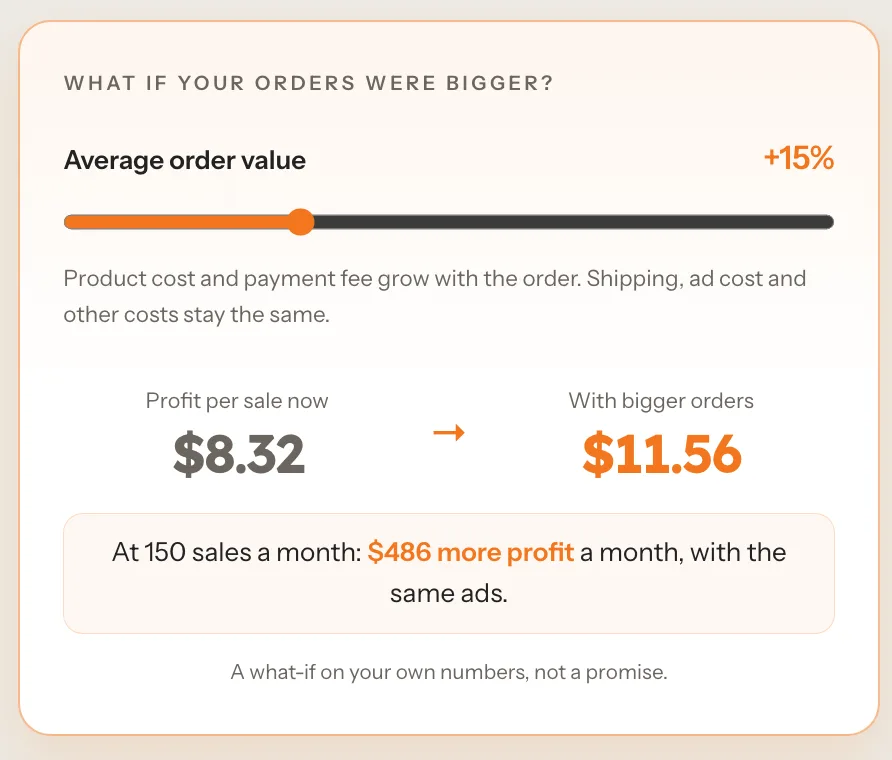
A bigger order adds revenue without adding an ad cost, while more ad spend adds an ad cost to every new order. Here's the profit margin calculator's example store: a $29.99 product, $7.50 product cost, $3 shipping, $9 ad cost per sale, $1 other costs and the 2.9% + $0.30 payment fee, selling 150 orders a month.
Orders 15% bigger means 15% more product in the order, so the product cost grows to $8.63 and the payment fee to $1.30. Shipping, the ad cost and the other costs stay the same. That leaves $11.56 per order instead of $8.32, about $486 more a month.
To earn the same $486 with ads, the store needs about 58 more orders at $8.32 each. At $9 per order, that's about $522 more ad spend every month. And that's the best case, because it assumes the ad cost per sale stays at $9 as the budget grows.
How Much More Profit Would Bigger Orders Make for Your Store?
Put your own numbers into the profit margin calculator and move the what-if slider. It raises the order value by the percentage you pick, grows the product cost and payment fee with it, and keeps shipping, ad cost and other costs the same.
Bigger orders also lower the ROAS you need. In the example, the break-even ROAS drops from 1.73x to 1.68x, so the same ads have more room before they lose money. The ROAS calculator shows your ROAS next to your break-even ROAS for your own budget.
What's the Quickest Way to Increase Average Order Value?
- Vitals - All in One App is the quickest way to increase average order value for most stores
- Vitals also offers 40+ apps, such as upsells, product bundles and a cart drawer, in one subscription from $29.99/month, so you don't have to install and pay for each app separately
The main offers compare like this. For a list of apps that make these offers, see our roundup of the best Shopify apps to increase AOV.
How to Increase Average Order Value With an Upsell App?
Install the Vitals - All in One App, open its Upsell Builder app and pick the offer type that fits your best-selling product. The Vitals Upsell Builder app has eight offer types: volume discount, product bundle, buy X get Y, gift, spending goal, related products, product add-on and one-click post-purchase. Each one applies its discount at checkout automatically, so shoppers don't need a discount code.
Bundle Products That Sell Together
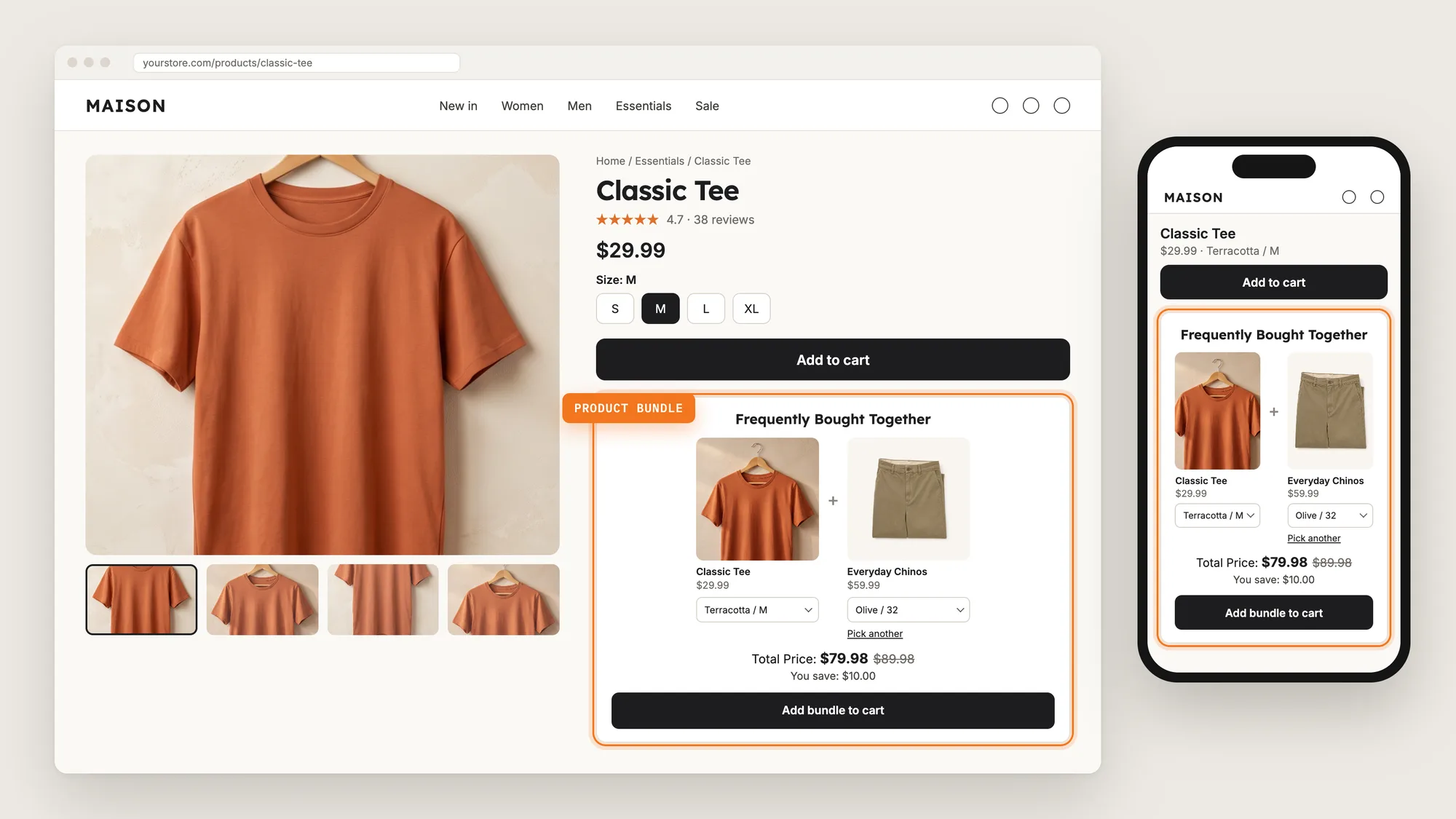
The Vitals Product Bundles app sells 2 to 5 products together at a bundle price, with one button that adds the whole set to the cart. You can make fixed bundles, mix-and-match bundles, frequently bought together bundles, same-collection bundles and multi-packs. Our guide on how to create product bundles on Shopify shows the setup step by step.
Lower the Price of the Second Unit
The Vitals Volume Discounts app shows quantity tiers next to Add to Cart, such as buy 2 and save 10%. You can discount each tier by a percentage, an amount or a fixed price, and add a gift to a tier.
Show a Free Shipping Goal
The Vitals Spending Goal app shows how much more a shopper needs to spend for free shipping or a discount, and applies the reward at checkout. You can set up to 10 reward tiers. Set the goal a little above your current AOV, so most shoppers are one item away. Our guide on how to add a free shipping bar to Shopify covers the setup.
Sell More From the Cart
The Vitals Cart Drawer app opens the cart in a panel over the page. It shows your Vitals Upsell Builder app offers above the checkout button, add-ons such as gift wrap, and the spending goal, so shoppers see the offer while they're still deciding.
Offer One More Product After Payment
A one-click post-purchase offer shows a product after the shopper pays and adds it to the same order in one click. It works best for small add-ons that go with what the shopper just bought, through the Vitals Upsell Builder app.
How Often Do Shoppers Take an Upsell Offer?
At the typical store, 4.8% of orders involve an upsell offer. We looked at 6,484 Shopify stores running the Vitals Upsell Builder app over 90 days. Among the 2,557 that showed offers at least 1,000 times:
- At the median store, 4.8% of orders involve an offer
- In the top 10% of stores, 26.2% of orders involve an offer
- The median store earns $114 for every 1,000 times an offer is shown
These numbers are attribution, not a controlled test: they count orders that carry an offer, not orders the offer created. The gap between the median and the top 10% shows how much the choice and placement of offers matter. For offer ideas to test, see our Shopify upsell ideas and tips.
How to Increase Average Order Value Without Losing Your Margin?
Check the profit per order of every offer before it goes live, because a discount comes straight out of your margin. A bigger order is only worth it if it leaves more profit than the order it replaces.
Take the example product with a buy 2, save 10% tier. The order is $53.98, the product cost is $15.00 and the payment fee is $1.87. If both units ship in one box for the same $3, with the same $9 ad cost and $1 other costs, the order leaves $24.11 against $8.32 for a single unit.
- Price the discount from your margin, not from what competitors offer
- Put the deepest discount on the third unit, so the second unit still earns well
- Count shipping again if two units need a bigger box or a heavier rate
- Use a free gift or free shipping as the reward when a percentage off costs more
How to Increase Average Order Value From Your Theme Settings?
Some themes include a related products section or a cart note, and some show a free shipping message. To check yours:
- Open Online Store, Themes, and click Customize.
- Open a product page template and look for a related or complementary products section.
- Open the cart and look for a cart drawer or upsell setting.
Theme sections usually show products without a discount or a price for the set, so they work as suggestions rather than offers.
How to Increase Average Order Value Without an App?
Create the discounts in Shopify and promote them yourself. Shopify discounts can give an amount off a product, a collection or the whole order, a buy X get Y deal or free shipping, as a code or applied automatically, as Shopify's discount types page lists. The work involves:
- Creating each discount in the Shopify admin.
- Adding text or a banner to your product pages that explains the deal.
- Updating that text by hand whenever the offer changes.
A code-based discount only works when the shopper remembers to type it.
Which AOV Method Should You Choose?
Pick the method that fits how shoppers already buy from you. If you're not sure where to start, a volume discount on your best seller is the easiest first offer, because it needs no second product.
- Choose Vitals - All in One App if you want bundles, volume discounts, a spending goal and cart offers live today, with discounts applied at checkout
- Choose your theme's settings if you only want related product suggestions with no discount
- Choose Shopify discounts by hand if you run one simple offer, such as one buy X get Y deal
Start your free trial: Install the Vitals - All in One App
Frequently Asked Questions
1. What is the best way to increase average order value on Shopify?
Vitals - All in One App is the best way for most stores. It adds bundles, volume discounts, a free shipping goal, cart offers and post-purchase offers, with the discount applied at checkout.
2. Why is increasing AOV better than spending more on ads?
A bigger order adds revenue without a new ad cost. In the profit margin calculator's example, orders 15% bigger add about $486 profit a month with no new ad spend, while ads would need about $522 more a month to bring the same profit.
3. How do I calculate average order value on Shopify?
Divide your revenue by your number of orders. Shopify uses gross sales minus discounts, divided by orders, and shows it in the Average order value over time report under Analytics, Reports.
4. What is a good average order value for Shopify?
A good AOV is one that leaves you a healthy profit per order after product cost, shipping, ads and fees. Work out your profit per sale in the profit margin calculator, then aim to raise AOV until your break-even ROAS sits clearly below the ROAS your ads get.
5. Do discounts lower my profit when I raise AOV?
They can. Check the profit per order with the discount in place. A buy 2, save 10% offer on a $29.99 product can leave $24.11 per order instead of $8.32, but only if shipping and other costs don't grow with the second unit.
6. Does a free shipping bar increase average order value?
It can, when the goal sits a little above your current AOV. Shoppers who are one item away from free shipping have a reason to add it. Set the goal from your own AOV, not from a round number.
7. How many upsell offers should I run at once?
Start with one offer on your best-selling product, then add another after you see its results. In our data from stores with 1,000+ offer views, the top 10% had 26.2% of orders involve an offer, against 4.8% at the median store.